Showing posts with label British Empire. Show all posts

For many centuries, the Dutch dominated the lucrative spice and opium trade of South East Asia, and the British East India Company (EIC) first attempted to enter it by establishing a pepper-trading center and garrison at Bencoolen (Bengkulu) on the South-West coast of Sumatra in 1685.

For a time, Bencoolen was a Presidency in its own right, and controlled the administration of other British factories along the West coast of Sumatra. As it was far away from the primary regional trade routes however, Bencoolen functioned mainly as a penal colony - it could not successfully produce pepper as planned and it became a financial loss to the EIC. Despite this chequered history, Bencoolen was in fact the last territory in Indonesia to be held by the British.

British expansion throughout South East Asia in the latter part of the 18th century began to focus on the Malacca Straits. In 1765, Captain Francis Light of the British EIC was tasked with establishing better trade relations in South East Asia. Light was posted to North-West Sumatra, where he quickly attained an influential position with the Sultan of Kedah. From 1771, he was involved in various proposals to cede portions of the Sultan's land to the British.

In 1786, Light reported to the Bengal Government that he had persuaded the Sultan to cede the Island of Penang to the British EIC for $6,000 a year. The offer was accepted - Light was appointed the first Superintendent of the new British colony, and became the colony's principal merchant.

By 1791, the Sultan of Kedah found that his revenues were being seriously diminished by the growing prosperity of Penang - he demanded additional income to compensate for this loss and made preparations to seize the island. Light obtained reinforcements from Bengal, and captured the Sultan's fort. The Sultan sued for peace and a treaty was agreed - the Sultan was granted an annual payment of $6,000, on the condition that the English could continue in possession of Penang.
Following the outbreak of the French War with England in February 1793, and the threat that this posed to English trade in the East, Light called for the reinforcement of troops in Indian waters. He also set about rebuilding Penang's defences. Naval reinforcements arrived in Madras at the end of 1793. Francis Light died from malaria on 21 October 1794.

In 1791 the subsidy was changed to $6,000, in perpetuity - for some years later this was raised to $10,000. This final addition was made when Province Wellesley was purchased by the East India Company for $2,000 in 1798.

In 1796, Penang was made a penal settlement, and 700 convicts were transferred there from the Andaman Islands. In 1805, Penang was made a separate presidency (equal in stature with Bombay and Madras); and in 1819, Britain sent Sir William Raffles to establish a trading post on Singapore Island. In 1824, the Dutch signed a treaty which surrendered their possessions on the Malay Peninsula to the British.

When administration of Penang was incorporated with Singapore and Malacca in 1826, it continued to be the seat of British government in South East Asia. Penang was reduced from the rank of a presidency in 1829, and eight years later, the town of Singapore was made the capital of the Straits Settlements.

The dollar was the currency of British colony of Bencoolen (also known as Fort Marlborough), and was equal in value to the Spanish dollar. Each dollar was subdivided into four suku, each suku then divided into 100 keping. After the Dutch took over control of Sumatra from the British in 1824, the dollar was replaced by the Netherlands Indies Gulden.

The proof copper coins for British Sumatra were presumably struck by the Soho Mint for the British Administrator at Bencoolen prior to the settlement at Penang being confirmed in June, 1786.

Generally available information is that in 1787, Matthew Boulton of the Soho Manufactory won a contract to strike coins for the East India Company's territory of Bencoolen on the island of Sumatra. It was the encouragement they received from the success of this venture that the Boulton, Watt & Son company began to actively develop minting equipment and the revolutionary mass production techniques that so transformed the production of coinage around the world.

Although the sheet copper and round blanks for the Bencoolen coinage were prepared at the Soho Manufactory, the coins were not actually struck there. The actual production occurred at a makeshift mint Boulton and John Scale set up in a warehouse at the French Ordinary Court in London1.

The Privy Council (which authorized the East India coinage), allowed just £200 for the purchase of up to three manual screw presses, which was incidentally a fraction of what it would eventually cost for Boulton to set up the Soho Mint's steam-powered equipment.

At the same time as the coinage for Bencoolen was being struck, a range of copper and silver coins were also being produced for the new settlement at Penang. The (Spanish) dollar was used as the basis of the currency used at Penang between 1786 and 1826, and was subdivided into 100 cents (pice). These coins also featured the British EIC balemark on the obverse, with the legend in Persian script on the reverse. In 1826, the Indian rupee was declared legal tender in Penang.

To the degree that the copper coins of Bencoolen pre-date the coinage struck by the British for use at Penang, they are an excellent record of the early efforts of the British to gain a toe-hold in the lucrative spice and opium trade of South East Asia.
As the very first coins struck by Matthew Boulton – indisputably the father of industrialized coinage, the copper coins of Bencoolen are of further importance to collectors of British and British colonial coinage.

Submitted by Andrew Crellin on Tue, 06/10/2008

Source:
http://sterlingcurrency.com.au/node/627

Publication: Journal of Southeast Asian Studies
Publication Date: 01-MAR-00
Author: Andaya, Barbara Watson

COPYRIGHT 2000 Cambridge University Press

Bencoolen. A History of the Honourable East India Company's Garrison on the West Coast of Sumatra 1685-1825. By ALAN HARFIELD. Barton-on-Sea: A & J Partnership, 1995. Pp. xx, 624. Maps, Plans, illustrations, Bibliography, Index.

This rather large book is a history of the English military garrisons on the West Coast of Sumatra from the late seventeenth century until Bengkulu was ceded to the Netherlands by the Anglo-Dutch Treaty of 1824. The framework for the narrative is provided by documents contained in the India Office and other collections in the United Kingdom, the Netherlands, France and Singapore, either reproduced verbatim or closely paraphrased. There are also a number of line drawing, photos and illustrations pertinent to military matters. In many ways the volume thus serves as a companion to John Bastin's The British in West Sumatra, 1685-1825 (Kuala Lumpur: University of Malaya Press, 1965), which is more concerned with the civilian establishment.

Bencoolen: A History was intended as a reference work "mainly for use in schools, libraries and such like in Indonesia" (p. xv), and the author's commitment to the project is overwhelmingly evident. A number of subscribers (and presumably by the author as well) met the expenses involved in producing the limited edition of two hundred copies. There is little doubt that Bengkulu authorities will be delighted with a monograph that concentrates on local history and historical buildings. They will not be concerned at its length, its lack of any sustained argument, the tendency to repetition, or even the archaic language that renders the meaning of several documents obscure. Given that the book was intended to provide information rather than attempt a historical analysis, and remembering the arduous work involved in transcribing sources, it would be churlish to submit it to the kind of scrutiny normally applied to academic studies.

Because the book is about the English garrison and their concerns, not a great deal can be gleaned about indigenous society. For example, in comparison to the documents supplied by Bastin, the material here gives very little about the relationship between the coastal authorities and the "hill rajas". In his introduction, however, the author comments that he has provided only a selection of relevant documents. "There is", he notes, "ample scope for further research." Since the English sources are infinitely less revealing than the Dutch East India Company material generated at the same time, it might have been helpful for students to be given some indication of where possible lines of inquiry might lie.

Like so many "migrant" groups in Southeast Asia, the garrison at Benkulen was made up of young men, whose unmarried status was specified in a 1685 source calling for new recruits. The restrictions placed on them meant that for many their existence became a kind of dull banishment. A social history might try and track the reasons "able young men" decided to take up a soldiering career, and the ways in which they made sense of their lives. Presumably one of their preoccupations was financial gains, and indeed complaints of venality and corruption are constant. The presence of so many young males should also hold out some potential for research into gender history. There were few single European women in Benkulen, and one sent back to England for being "turbulent and incorrigible" was probably typical. They were considered undesirable helpmates, and the lack of marriageable white females resulted in considerable interaction between the garrison and local women, despite efforts to maintain a correct moral tone. There is certainly evidence of miscegenation in West Sumatran sources, and a few men born of these liaisons gained positions in the civil and military establishments. However, these relationships worked on other levels as well; for example, uniforms were made up locally according to specific designs, with cloth and materials sent from England. Though the gender of local tailors is unmentioned, presumably women would have been among those introduced to new techniques of design such as fitted sleeves, darts, and turned lapels. A historian of disease will also find much of interest here in what must have been a quite depressing rate of debilitation and death. It is sobering to think of the small tragedies which must lie behind the brief comment that "our men ... drop off fast" (p. 100). Those interested in ethnic relations will also find intriguing titbits, and the history of local forces like the "Sumatra Hill Rangers" formed under the British might also be an intriguing avenue of research. References through t he volume affirm that the ethnic categories we often accept unquestioningly are highly fallible. For example, in 1742 the garrison commander comments that no Bugis had been recruited for "many years" and that the soldiers then classed as "Bugis" were mostly Malay (p. 100). By 1808 it was said that the officers of the "Bugis Corps" were "men of the first consideration and influence in Bencoolen", and were used as agents with the "aboriginal inhabitants" (p. 401). The provenance of the "Arab" troops who were initially at least preferred to "Bugguesses" is unclear, but it is likely that they had connections with Muslim India, possibly Malabar. A related field of inquiry concerns the convicts brought to Sumatra from Madras and Bengal. But perhaps the real goldmine awaits those working on the history of architecture in Southeast Asia, since it is known from other sources that local societies were quick to adopt aspects of European military fortifications. The plans of fortifications and detailed descriptions of bu ildings that employed local materials such as resins and red ochre provide intriguing insights into the way in which the English themselves were subject to the localization process.

The arduous work involved in preparing historical documents for publication is insufficiently appreciated, but it is always a service. At the very least, books like this help the researcher know what he or she will not find. Although the documents provided here are not rich in details about indigenous society, the careful reader will be able to winkle out small pieces of useful material. For those working on the social history of Europeans the volume will have a much greater value, and it is in this area that I expect to find the volume cited.

Source:
http://www.accessmylibrary.com/coms2/summary_0286-670029_ITM?
email=taneakjang@gmail.com&library=Buffalo

Hubungan yang terjalin antara rakyat Propinsi Bengkulu dengan Inggeris sudah berjalan sejak lama, yakni sejak abad ke 17. Pada tahun 1682 Kompeni Belanda (VOC) mampu mengungguli the Honourable East India Company (EIC), khususnya setelah tercapai kesepakatan antara VOC dengan kerajaan Banten mengenai monopoli perdagangan rempah-rempah. Hal ini memaksa EIC keluar dari Jawa dan harus mencari tempat pangkalan baru yang secara politik dan militer dapat menguntungkan mereka dalam perdagangan rempah-rempah.
Pada awalnya mereka berkeinginan untuk mendirikan faktori dagang di Aceh, namun keinginan ini ditolak oleh Ratu Aceh Sultana Zaqiyat -ud-udin Inayat Shah. Penolakan ini membuat EIC berpaling ke wilayah lain yang bersedia untuk menerima mereka, yakni Pariaman dan Barus di Sumatera Barat. Keinginan kedua wilayah ini untuk menerima EIC didorong oleh kekuatiran terhadap kekuatan Belanda yang sangat agresif. Namun pada akhirnya pilihan EIC jatuh kepada Bengkulu, ada dua versi catatan sejarah yang menyebabkan terjadinya perubahan pilihan ini, yakni :

1. Menurut buku “Bencoolen : A History of the Honourable East India Company’s Garrison on the West Coast of Sumatra (1685 – 1825)”, yang ditulis oleh Alan Harfield (1995), perubahan ini disebabkan adanya surat permintaan dari para penguasa di Bengkulu yang mereka terima dua hari menjelang keberangkatan utusan EIC (Ord dan Cawley) dari Madras menuju Pariaman.

2. Menurut buku “Bengkulu dalam Sejarah”, yang ditulis oleh Firdaus Burhan (1988), perubahan ini disebabkan oleh kesalahan navigasi dalam pelayaran dari Madras menuju Pariaman dan adanya permintaan dari para penguasa Bengkulu setelah utusan EIC tersebut mendarat di Bengkulu.

Terlepas dari adanya perbedaan di atas, sejarah mencatat bahwa Inggeris (EIC) pada akhirnya bercokol di Bengkulu dan rakyat Bengkulu menerima kehadiran mereka. Setibanya mereka di Bengkulu pada tahun 1685, pihak Inggeris disambut oleh petinggi Bengkulu pada masa itu, yakni Orang Kaya Lela dan Patih Setia Raja Muda. Dalam beberapa pertemuan selanjutnya pihak Inggeris memperoleh izin untuk mendirikan faktori di Bengkulu dan menjalin hubungan dagang dengan para penguasa Bengkulu. Pangkalan pertama yang didirikan oleh Inggeris di Bengkulu adalah Fort York. Sejak saat itu Inggeris menamakan faktori dagang mereka di Bengkulu sebagai Garnizun EIC di Pantai Barat pulau Sumatera (the Honourable East India Company’s Garrison on the West Coast of Sumatra).
Kehadiran Inggeris di Bengkulu berlangsung selama 140 tahun, yaitu dari tahun 1685 sampai dengan bulan Maret 1825, ketika seluruh kekuatan Inggeris meninggalkan Bengkulu. Berakhirnya kehadiran Inggeris di Bengkulu adalah disebabkan adanya perjanjian antara Raja Inggeris dan Raja Belanda, yang ditanda-tangani pada tanggal 17 Maret 1824. Perjanjian ini oleh pihak Inggeris disebut “the Anglo-Dutch Treaty of 1824", sedangkan pihak Belanda menyebutnya sebagai “Traktat London”. Perjanjian ini mengatur pertukaran kekuasaan Inggeris di Bengkulu dengan kekuasaan Belanda di Melaka dan Singapura (Singapura pada masa itu merupakan bagian dari kerajaan Melaka).

PEMBANGUNAN FORT MARLBOROUGH

Pada tahun 1714 kondisi Fort York menjadi kritis. Bangunan benteng dan barak-barak telah semakin rapuh dan air hujan secara terus-menerus membasahi ruangan-ruangan tempat tinggal para penghuni. Selain itu, kondisi bahan makanan yang dikonsumsi oleh tentara Inggeris sangat buruk sehingga disiplin para prajurit dan pegawai benteng menjadi turun. Berbagai macam penyakit, umumnya disentri dan malaria, telah menyebabkan sebagian besar prajurit garnizun tidak dapat menunaikan tugas mereka. Joseph Collet yang menjadi pimpinan Garnizun Bengkulu pada tahun 1712 menarik kesimpulan bahwa Fort York membutuhkan perbaikan-perbaikan besar dan lokasi benteng itu sebenarnya tidak tepat. Oleh sebab itu pada tanggal 27 Februari 1712 Collet menulis surat kepada Dewan Direksi EIC yang mengusulkan agar membangun benteng baru di tempat yang disebut “Carrang” (orang Bengkulu menyebutnya Ujung Karang). Lokasi Carrang yang diusulkan oleh Collet terletak lebih kurang dua mil dari Fort York. Usul Collet untuk membangun benteng baru disetujui oleh Dewan Direktur EIC dan pembangunan benteng baru tersebut dimulai pada tahun 1714.
Benteng baru yang dibangun di Carrang diberi nama Marlborough. Nama ini dipilih oleh Joseph Collet untuk menghormati John Churchill, seorang komandan ternama Inggeris yang pernah memenangkan pertempuran di Blenheim (1704), Rammilies (1706), Oudenarde (1708) dan Malplaquet (1709). Atas jasa-jasanya ini John Churchill kemudian diberi gelar “Duke of Marlborough”. Benteng baru yang dibangun oleh Joseph Collet ini kemudian dikenal dengan nama “Fort Marlborough”. Pembangunan Fort Marlborough selesai seluruhnya pada tahun 1741.

PEMAKAMAN INGGERIS DAN MONUMEN THOMAS PARR

Selama 140 tahun berada di Bengkulu, orang-orang Inggeris banyak yang meninggal dunia. Kematian orang-orang Inggeris tersebut kebanyakan disebabkan oleh serangan penyakit, umumnya malaria dan disentri, dan tewas dalam konflik-konflik dengan rakyat Bengkulu. Orang-orang Inggeris yang meninggal di Bengkulu pada masa itu tercatat sebanyak 709 orang. Apabila diambil angka rata-rata maka selama 140 tahun 5 orang Inggeris yang meninggal setiap tahunnya. Sebagian dari orang-orang Inggeris tersebut dimakamkan di pemakaman Inggeris di Jitra, Bengkulu.
Di Bengkulu pada tahun 1808 dibangun sebuah monumen atau tugu peringatan bagi bangsa Inggeris dalam zaman kompeni dulu. Monumen ini disebut oleh orang-orang Bengkulu dengan istilah “Kuburan Bulek (kuburan Bulat)”. Nama sebenarnya dari Kuburan Bulek ini adalah Monumen Parr (Parr Monument). Monumen ini dibuat oleh Inggeris untuk mengenang pengalaman pahit bangsa Inggeris karena di tempat itu dikuburkan Residen Inggeris Thomas Parr, bersama-sama dengan seorang asistennya, yang terbunuh dalam satu insiden dengan rakyat Bengkulu pada malam tanggal 27 Desember 1807. Pembunuhan terhadap Thomas Parr ini disebabkan oleh akumulasi rasa tidak puas rakyat Bengkulu terhadap kebijaksanaan yang ditempuh oleh penguasa Inggeris. Kebijaksanaan Parr yang menimbulkan ketidakpuasan di kalangan pribumi, antara lain pemberlakuan tanam paksa kopi dan pengubahan yang besar dalam peradilan pribumi tanpa persetujuan dan tanpa meminta nasehat dari para Kepala Adat rakyat Bengkulu.

BUNGA RAFFLESIA ARNOLDI

Sir Thomas Stamford Raffles diangkat menjadi Gubernur Bengkulu pada tahun 1818. Dia tiba di Bengkulu pada bulan Maret 1818 didampingi oleh isterinya Lady Sophia Raffles dan seorang Kepala Adat Jawa Raden Rana Dipura. Dalam perjalanan dari Inggeris ke Bengkulu, Lady Sophia Raffles melahirkan seorang anak perempuan yang diberi nama Charlotte Sophia Tanjung Segara Raffles. Ketika Raffles tiba di Bengkulu dia menemukan Bengkulu yang luluh lantak akibat gempa bumi, oleh karena itu kota Bengkulu disebut dengan istilah “Tanah Mati”. Namun setelah itu, Raffles bersama-sama dengan rakyat Bengkulu membangun dan membangkitkan kembali Kota Bengkulu dari puing-puing Tanah Mati.
Gubernur Raffles bertugas di Bengkulu selama 6 tahun, yaitu dari tahun 1818 sampai tahun 1824. Selama bertugas di Bengkulu Raffles banyak melakukan perjalanan ke daerah-daerah pedalaman. Dalam salah satu perjalanannya, Raffles dengan didampingi isteri dan Dr. Arnold (pakar Botani), singgah di Desa Pulau Lebar, Lubuk Tapi (Bengkulu Selatan). Di desa inilah Raffles menemukan bunga yang berukuran sangat besar dan indah. Penduduk setempat menamakan bunga ini Petimun Sikinlili Atau Sirih Hantu. Bunga tersebut kemudian diberi nama Rafflesia Arnoldy, diambil dari nama Raffles dan Dr. Arnold. Bunga Rafflesia Arnoldi saat ini sudah menjadi simbol Propinsi Bengkulu yang dikenal dengan nama “Bumi Rafflesia”. Bunga Rafflesia pada masa kini masih sering ditemukan di Kawasan Hutan Lindung Rejang Lebong dan Desa Talang Tais di Kecamatan Kaur Utara (Bengkulu Selatan).

Bengkulu, 28 Juni 2000.

(H. Musiardanis)

Disarikan dari :

1. Buku “Bengkulu dalam Sejarah”, oleh Firdaus Burhan (1988)
2. Buku “Bencoolen : A History of the Honourable East India Company’s Garrison on the West Coast of Sumatra (1685 - 1825), oleh Alan Harfield (1995).
3. Ensiklopedi Indonesia Buku 6 (1983).

Source:
http://musiardanis.multiply.com/reviews/item/5

Q : When Bencoolen founded by British?

A : British Bencoolen (founded in 1685)

Indian convicts provided labour for early building and road projects in Singapore; they cleared jungles and filled swamps and helped to building among others the St Andrew's Cathedral, the Istana, government offices, early defence works and Horsbugh Lighthouse.

British Bencoolen (founded in 1685) in South West Sumatra was a British penal settlement. Indian convicts were transported there various petty crimes.The Anglo-Dutch Treaty 1824 created two spheres of influence in the East Indies-British and Dutch. British Bencoolen was exchanged for Dutch Malacca so that Penang, Malacca and Singapore came under British influence in the Malay Peninsula.

When Bencoolen was vacated, the British transferred the Indian convicts to Singapore in 1826. The convicts first occupied the Temenggong's Village (vacated by the Temenggong who moved out to Telok Blangah) near the Singapore River. Later they moved to permanent buildings erected for them between Bras Basah Road and Stamford Road.

At one time they were about 2,000 convicts. They were deployed as labourers for the Public Works Department and were generally well-behaved and hard-working; they were supervised by their own fellow convicts. They contributed much towards the early development of Settlement: they build some of the most beautiful building existing today - the Istana and St Andrew's Cathedral; they build our early roads and filed up swamps to create Commercial Square (Raffles Place), Thomson Road and Bukit Timah. They were stone cutters for the Horsburgh Lighthouse and labourers for construction of early Singapore defence works.

The name 'Klings' was given to Indians. One theory is that the chains of the Indian convict clanged and the word 'Klings' was derived from the sound. Actually the word 'Kling' referred to Kalinga a place in India. The word 'Kling' was used more than 300 years before the founding of Singapore. The Tamils were referred to as Klings in Portuguese Malacca (1511-1641) and Kampong Kling was already a distinct settlement in Portuguese Malacca and Ducth Malacca (1641-1824).

The Indian Mutiny of 1857 spread baseless fear in Singapore. In 1867 when the Straits Settlements were transferred from the control of the India Office to that of the Colonial Office the Convicts were transferred to the Andaman and Nicobar Island in the Indian Oceans. Indian convict labour contributed much to the very early development of Singapore.


Source:
http://www.streetdirectory.com/travel_guide/singapore/facts_old_singapore/326/indian_oldconvict_settlement_in_singapore.php

[Flag of the United Kingdom]

1685 British rule (Fort York); under the East India Company.
1685 - 1760 Subordinated to Madras (see India).
1714 Renamed Fort Marlborough.
1760 British Presidency of Bencoolen.
1785 - 1825 Subordinated to Bengal (see India).
1 Mar 1825 Part of Netherlands East Indies.

Deputy governors
1685 Ralph Ord
1685 - 1690 Benjamin Bloome
1690 - 1691 James Sowdon
1691 - 1695 Charles Fleetwood
1695 - 1696 Charles Barwell
1696 - 1699 Matthew Mildmay
1699 - 1700 Robert Broughton
1700 - 1705 Richard Watts
1705 - 1708 Matthew Ridley
1708 James Cross
1708 Abraham Hoyle
1708 John Delapie
1708 - 1710 Robert Skingle
1710 Jeremiah Harrison -Supervisor
1710 - 1711 Anthony Ettricke
1711 - 1712 John Daniell
1712 John Hunter
1712 - 1716 Joseph Collett
1716 - 1717 Theophilus Shyllinge
1717 - 1718 Richard Farmer
1718 - 1719 Thomas Cooke -Supervisor
1719 - 1723 Isaac Pyke
1723 Thomas Dunster
1723 - 1728 Joseph Walsh
1728 - 1730 Nicholas Morse
1730 - 1731 Stephen Newcome
1731 - 1736 Francis Everest
1736 - 1746 Robert Lennox
1746 - 1752 Joseph Hurlock
1752 - 1754 Robert Hindley
1754 - 1755 John Walsh -Supervisor
1755 - 1757 John Pybus
1757 - 1758 Randolph Marriott
1758 - 1760 Roger Carter
Governors
1760 - 1767 Roger Carter
1767 - 1776 Richard Wyatt
1776 Robert Hay
1776 - 1780 William Broff
1780 - 1781 Hew Steuart
1781 - 1785 Edward Coles
Deputy governors
1785 - 1786 John Crisp (1st time)
1786 - 1787 Thomas Palmer
1787 - 1789 George Salmon -Supervisor
1789 - 1793 John Crisp (2nd time)
1793 - 1799 Robert Broff
1799 John Crisp (3rd time)
1799 - 1800 Philip Braham
1800 - 1805 Walter Ewer
Residents
1805 - 1807 Thomas Parr (b. 17.. - d. 1807)
1808 - 1810 Richard Parry
1810 - 1812 William Parker
1812 - 22 Mar 1818 George John Siddons
Lieutenant governor
22 Mar 1818 - 1824 Thomas Stamford Bingley Raffles (b. 1781 - d. 1826)
Resident
1824 - 1 Mar 1825 John Prince

Source:
http://www.worldstatesmen.org/Indonesia.htm

Q : What colony in today's Indonesia was under British control for about 150 years from 1685?

A : Benkulen in Sumatra. The colony is also known as Bengkulu or Bencoolen.

flag

East India Company Flag


benkulen Map

Map of Benkulen


Benkulen

Benkulen Images


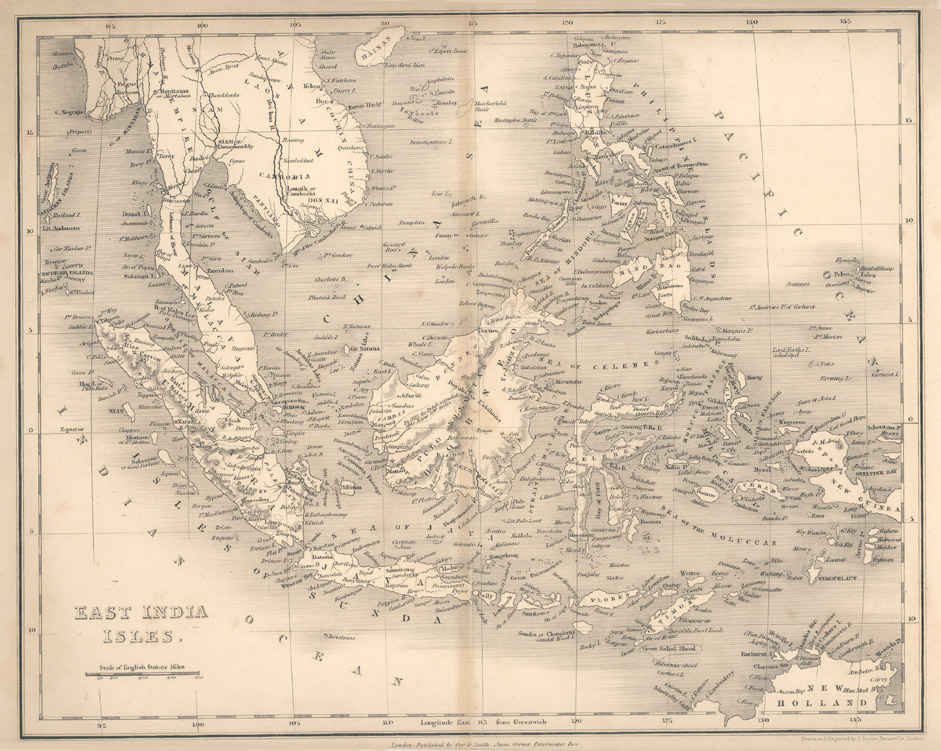
east indies islands1850

Brief History


Benkulen was set up shortly after the English East India Company was expelled from Bantam in 1682. The Dutch solicited and received the help of the local sultan in expelling the English in hopes of keeping control over the lucrative spice trade. Obviously, the English still wanted a slice of that very rich pie and so relocated to Benkulen on the island of Sumatra in 1685.

Indeed most of the pepper that had been exported from Bantam had actually been grown in southern Sumatra so it made sense for the English to redouble their efforts there. In 1685 the English negotiated a settlement at Benkulen, on the southwest coast near the important pepper collecting area of Silebar. the Dutch did try to intimidate the local Rajas under cover of suzerainty claims by their client Sultan of Bantam. However, the Sumatran rulers were keen to avoid having to pay for the luxury of selling their crops in Bantam when they could sell it directly in Benkulen.

Quickly, Benkulen came to dominate the sale of pepper to Europe in the eighteenth century, regularly sending between 453,600 and 907,200 kgs per year to London. In 1714, the English built Fort Marlborough to defend their profitable enclave from jealous rivals.

In the end, the port became a victim of its own success, as sailing ships got larger and faster and other areas were attracted to growing pepper the price of the commodity did ultimately fall. In the end, the British were content by 1825 to hand over the settlement in exchange for Malacca. This was largely due to the energetic influence of Benkulen's Lieutenant-Governor Thomas Stamford Bingley Raffles. He was of the opinion that Singapore would be far more strategically important in the long run - especially due to the direction of trade to and from China. Malacca was more strategically important in the approaches to this new colony of Singapore. Whereas Benkulen was on the wrong side of Sumatra.

Benkulen can also be spelt Bencoolen and Bengkulu.

Source:
http://www.britishempire.co.uk/maproom/benkulen.htm

Benkulen Administrators


Deputy Governors

Ralph Ord
1685

Benjamin Bloome
1685 - 1690

James Sowdon
1690 - 1691

Charles Fleetwood
1691 - 1695

Charles Barwell
1695 - 1696

Matthew Mildmay
1696 - 1699

Robert Broughton
1699 - 1700

Richard Watts
1700 - 1705

Matthew Ridley
1705 - 1708

James Cross
1708

Abraham Hoyle
1708

John Delapie
1708

Robert Skingle
1708 - 1710

Jeremiah Harrison
1710

Anthony Ettricke
1710 - 1711

John Daniell
1711 - 1712

John Hunter
1712

Joseph Collett
1712 - 1716

Theophilus Shyllinge
1716 - 1717

Richard Farmer
1717 - 1718

Thomas Cooke
1718 - 1719

Thomas Dunster
1719 - 1723

Joseph Walsh
1723 - 1728

Nicholas Morse
1728 - 1730

Stephen Newcome
1730 - 1731

Francis Everest
1731 - 1736

Robert Lennox
1736 - 1746

Joseph Hurlock
1746 - 1752

Robert Hindley
1752 - 1754

John Walsh
1754 - 1755

John Pybus
1755 - 1757

Randolph Marriott
1757 - 1758

Roger Carter
1758 - 1760
Governors

Roger Carter
1760 - 1767

Richard Wyatt
1767 - 1776

Robert Hay
1776

William Broff
1776 - 1780

Hew Steuart
1780 - 1781

Edward Coles
1781 - 1785
Deputy-Governors

John Crisp
1785 - 1786

Thomas Palmer
1786 - 1787

George Salmon
1787 - 1789

John Crisp
1789 - 1793

Robert Broff
1793 - 1799

John Crisp
1799

Philip Braham
1799 - 1800

Walter Ewer
1800 - 1805
Residents

Thomas Parr
1805 - 1807

Richard Parry
1808 - 1810

William Parker
1810 - 1812

George John Siddons
1812 - 22 Mar 1818
Lieutenant Governor
Thomas Stamford Bingley Raffles
22 Mar 1818 - 1824
Resident

John Prince
1824 - 1 Mar 1825


Source:
http://www.britishempire.co.uk/maproom/benkulen/benkulenadministrators.htm

Older Posts Home